
A dental implant is a titanium screw placed in the jawbone to replace a missing tooth, with an artificial tooth fitted on top. It fuses with the bone and works like a natural tooth root, restoring chewing, speech and your smile. In this article we have gathered how implant treatment unfolds, who it suits, how it differs from a bridge or a denture, and the little things that keep an implant going for many years, explained as plainly as we explain them to our patients in the clinic every day.
What Is a Dental Implant?
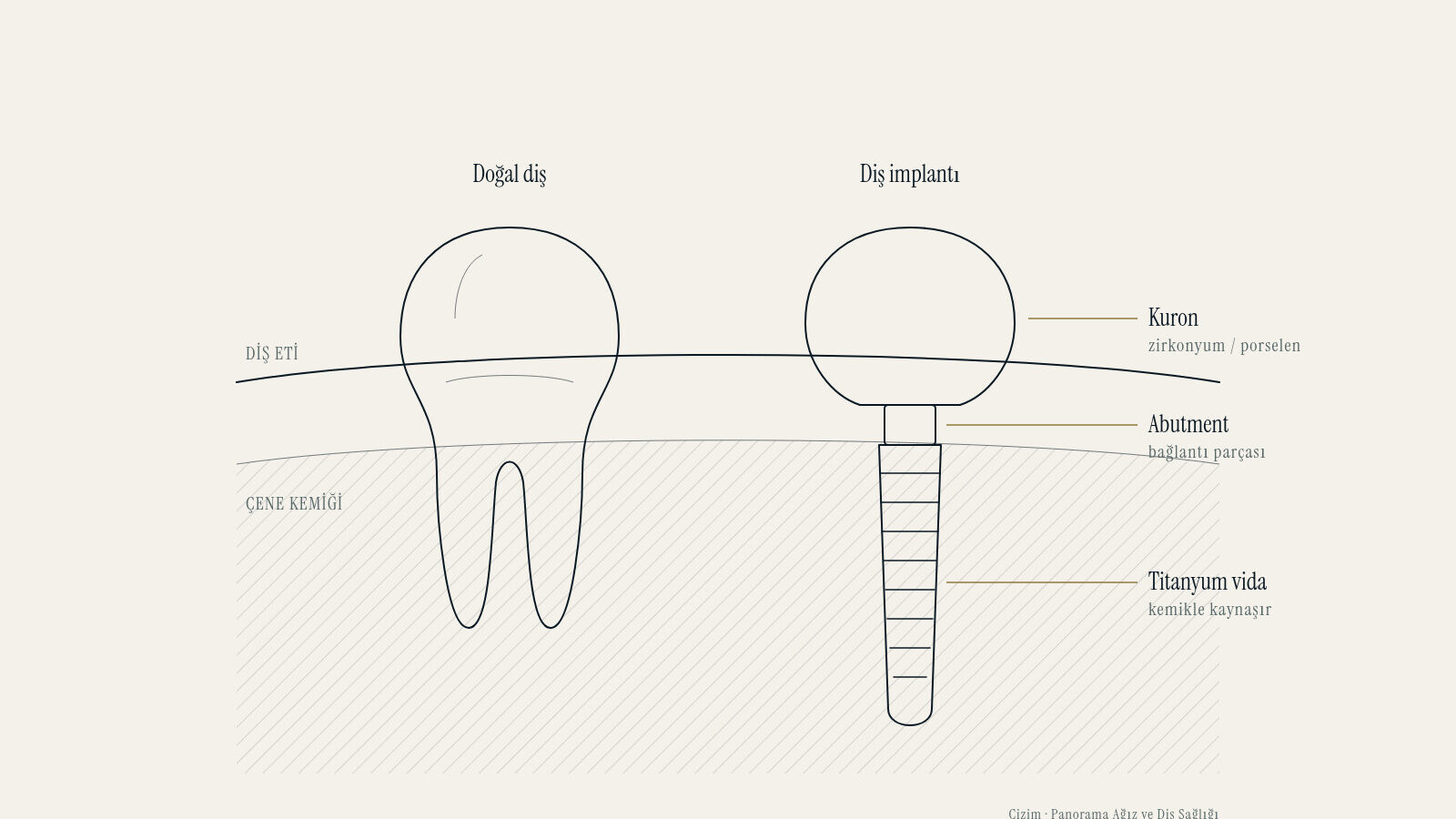
In short: an implant is a small titanium screw placed in the jawbone to take the place of a lost tooth root. Titanium is a metal the body does not treat as foreign, and bone can bond directly to its surface. That is why an implant integrates with the bone within a few months; dentists call this osseointegration. Once integration is complete, a connector and a crown are fitted on top, and the result is the closest thing to a natural tooth in both appearance and function.
Let us be clear from the start: an implant is not used to “rescue” a decayed tooth; it replaces a tooth that has already been lost. If the tooth is still in the mouth, tooth-saving options such as root canal treatment or a crown are discussed first. An implant comes into the picture only when extraction is unavoidable.
The three parts of an implant
- Fixture (the screw): The titanium root that stays inside the bone. Its length and diameter are chosen according to the patient’s bone volume.
- Abutment (the connector): The intermediate piece that joins the screw to the crown. It sits above the gum line.
- Crown: The visible artificial tooth. Usually zirconia or porcelain; its shade and shape are matched to the neighbouring teeth.
Who Can Have Dental Implants?
Anyone whose jaw has finished growing, whose general health allows a surgical procedure and whose gums are healthy can be a candidate. Age alone is not a barrier; we have patients in their seventies who have had implants. Three things matter most:
- Bone volume: There must be enough bone height and width for the screw to anchor into.
- Gum health: Untreated gum disease spreads to the tissue around an implant too. If your gums bleed, periodontal treatment comes first; we have covered the causes of bleeding gums in a separate article.
- General health: Uncontrolled diabetes, certain bone medications (bisphosphonates), recent radiotherapy to the head and neck, and heavy smoking can change the plan. None of these mean “no”; they are things your dentist needs to know so the plan can be built around them.
What if there is not enough bone?
If a tooth was extracted a long time ago, the bone in that area gradually shrinks because it is “out of work”. When the scan shows insufficient volume, the area is built up with a bone graft; in the back of the upper jaw, where the sinus floor is close, a sinus lift is performed. In some cases the graft and the implant are placed in the same session; in others, a few months’ gap is needed. Which route to take becomes clear after the scan and examination; you can read more on our bone graft and sinus lift page.
How Are Implants Placed? The Implant Process Step by Step
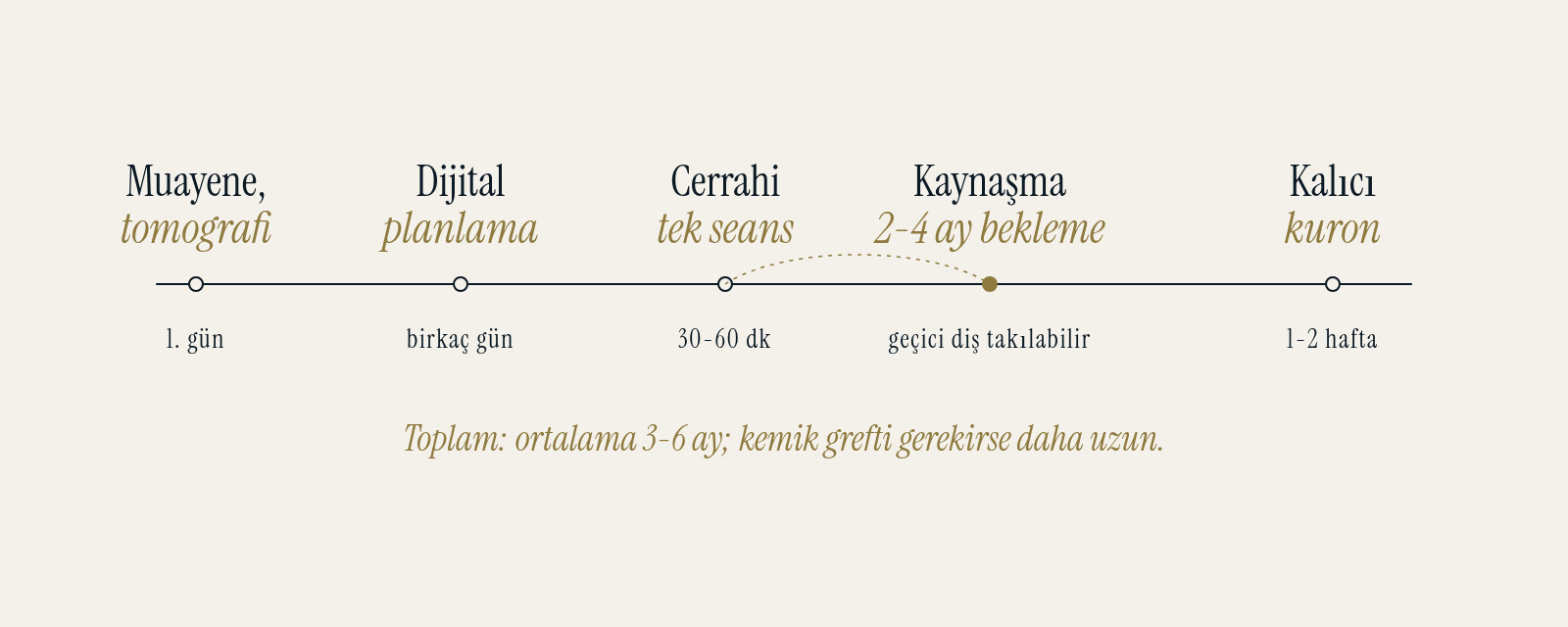
This is the question patients ask most. The implant process is not a single appointment; it is made up of five stages that follow one another. The timings are averages and vary with bone structure and how quickly you heal.
Preparing before treatment begins
Having a few things sorted out before the surgical appointment makes the whole process smoother. Any tartar should have been cleaned and any gum inflammation brought under control; placing an implant into an inflamed environment is the quickest route to failure. Always tell your dentist about the medications you take (especially blood thinners and osteoporosis drugs); some may need their dose adjusted together with your physician. If you have diabetes, keeping your blood sugar under control has a direct effect on healing. Finally, if you smoke, stopping at least a week before the operation noticeably improves the chances of successful integration.
1. Examination and CT scan
At the first appointment, your mouth is examined and a three-dimensional CT scan is taken. A panoramic X-ray alone is not enough; the CT scan shows bone thickness and the exact position of the nerve canal and the sinus to the millimetre. Without this image, a sound plan cannot be made.
2. Digital planning
The position, length, diameter and angle of the implant are planned on the computer using the CT scan. If needed, a surgical guide (a guide template) is produced so that the screw goes exactly where it was planned, at exactly the planned angle. At the end of this stage you receive a written treatment plan: how many implants, in what order, and at which stage a temporary tooth will be used.
3. The surgical stage
Under local anaesthesia, a small opening is made in the gum, the implant site is prepared in the bone and the screw is placed. For a single implant, the procedure usually takes 30-60 minutes. In some situations the extraction and the implant can be done on the same day (immediate implant); this requires no infection at the extraction site and sufficient bone.
4. The integration period (osseointegration)
Bone cells attach to the surface of the implant and wrap around the screw. This takes 2-3 months on average in the lower jaw and 3-4 months in the upper jaw. During this time a temporary tooth or a temporary denture can be fitted so that no gap shows. Patience matters here: an implant loaded before integration is complete has a harder time holding firm.
5. The prosthetic stage
Once integration has been checked, impressions are taken and the abutment and permanent crown are made. At the try-in, bite balance, shade and the fit with the gum are checked, and the crown is secured. This usually takes 1-2 weeks. A fixed single tooth, a bridge or a prosthesis carrying a whole jaw; all of them can be built on implants. You can find the options in detail on our fixed and removable prosthesis page.
Do Implants Hurt? What Happens During Recovery?
Let us be frank: thanks to local anaesthesia, you feel no pain during the procedure; most patients say “it was no different from having a tooth out”. In the 2-3 days after the anaesthetic wears off, there may be mild soreness, swelling and occasionally some bruising; these are easily managed with the painkiller your dentist recommends and cold compresses. Daily life returns to normal within a week.
A few simple rules speed up healing: avoid hot food and drinks for the first 24 hours, keep the surgical area clean with a mouth rinse rather than brushing it during the first days, do not smoke for at least two weeks, and if an antibiotic has been prescribed, finish the course. Stitches are usually removed after 7-10 days or dissolve on their own.
Implant, Bridge or Removable Denture?
There are three main options for a missing tooth, and each has its place. With a bridge, the healthy teeth on either side of the gap are trimmed down and a three-unit restoration sits on them; it is quick, but the neighbouring teeth are sacrificed. A removable denture is an economical, surgery-free solution, but it can move during the day and the bone beneath it shrinks faster under the pressure. An implant, on the other hand, leaves the neighbouring teeth untouched, keeps stimulating the bone and is cleaned like a natural tooth; in return, it asks for a surgical procedure and a wait of a few months.
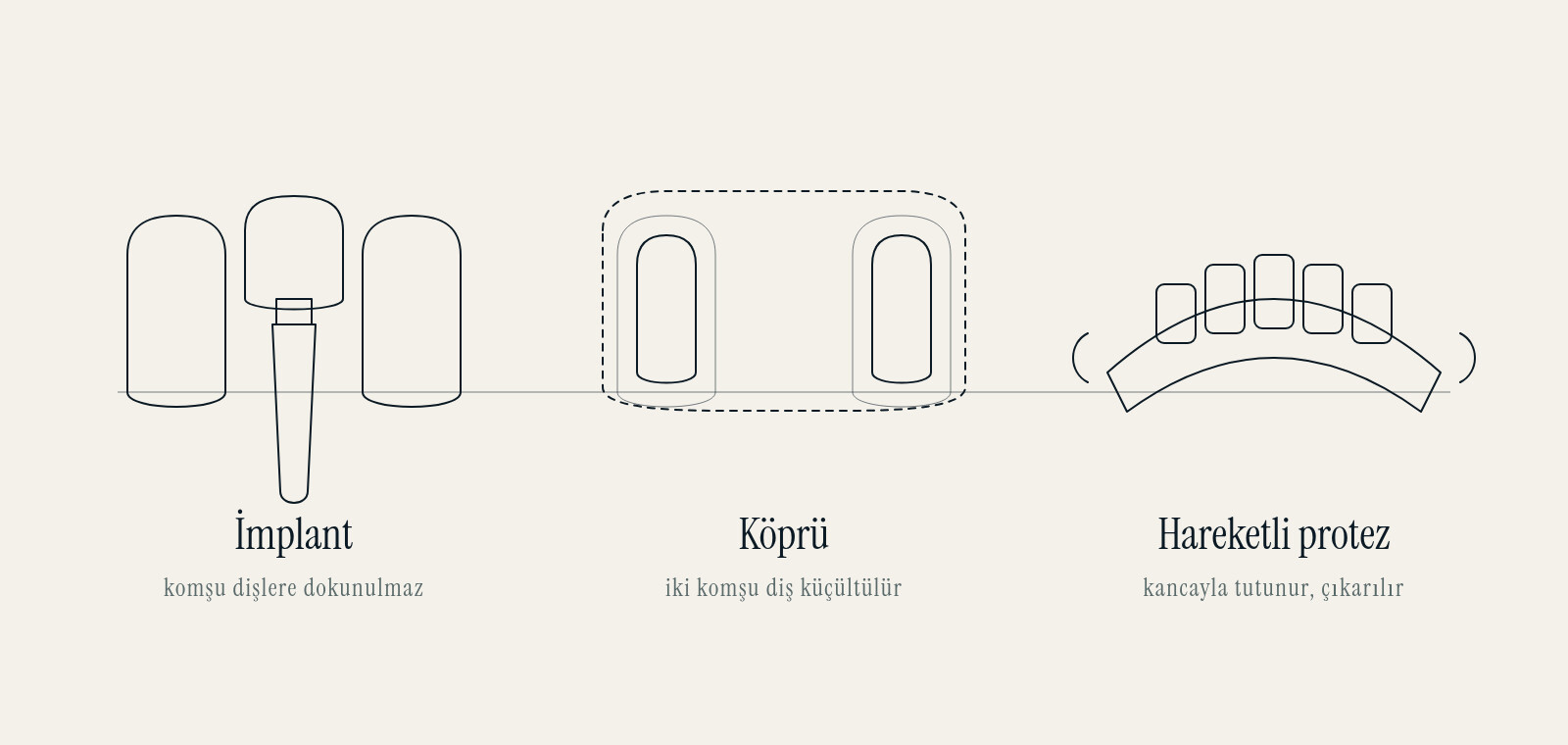
The decision is made together, weighing the condition of the neighbouring teeth, bone volume, budget and time. We discussed this in detail using five concrete criteria in our article Implant or bridge?
Types of Implant Treatment: Single Tooth, Several Missing Teeth and a Fully Toothless Jaw
“Implant” is not a single product; different plans are made depending on the pattern of tooth loss. A single-tooth implant closes the gap left by one lost tooth without touching the neighbouring teeth at all. If two or three adjacent teeth are missing, instead of placing an implant in every gap, an implant-supported bridge can be built on two implants; this reduces the number of implants and preserves the natural teeth. When no teeth remain in the jaw, there are two routes: an implant-retained snap-on denture (removable, but locks into place) or a completely fixed prosthesis carried by four to six implants.
The size of the screw also varies with the plan. Standard implants are used in most areas, while narrower-diameter implants may be preferred where the bone is thin; where bone height is very limited, short implants come into play to keep a safe distance from the nerve or the sinus. Which one is used is decided by the CT measurements, not by preference.
If All Teeth Are Missing: All-on-4 and All-on-6
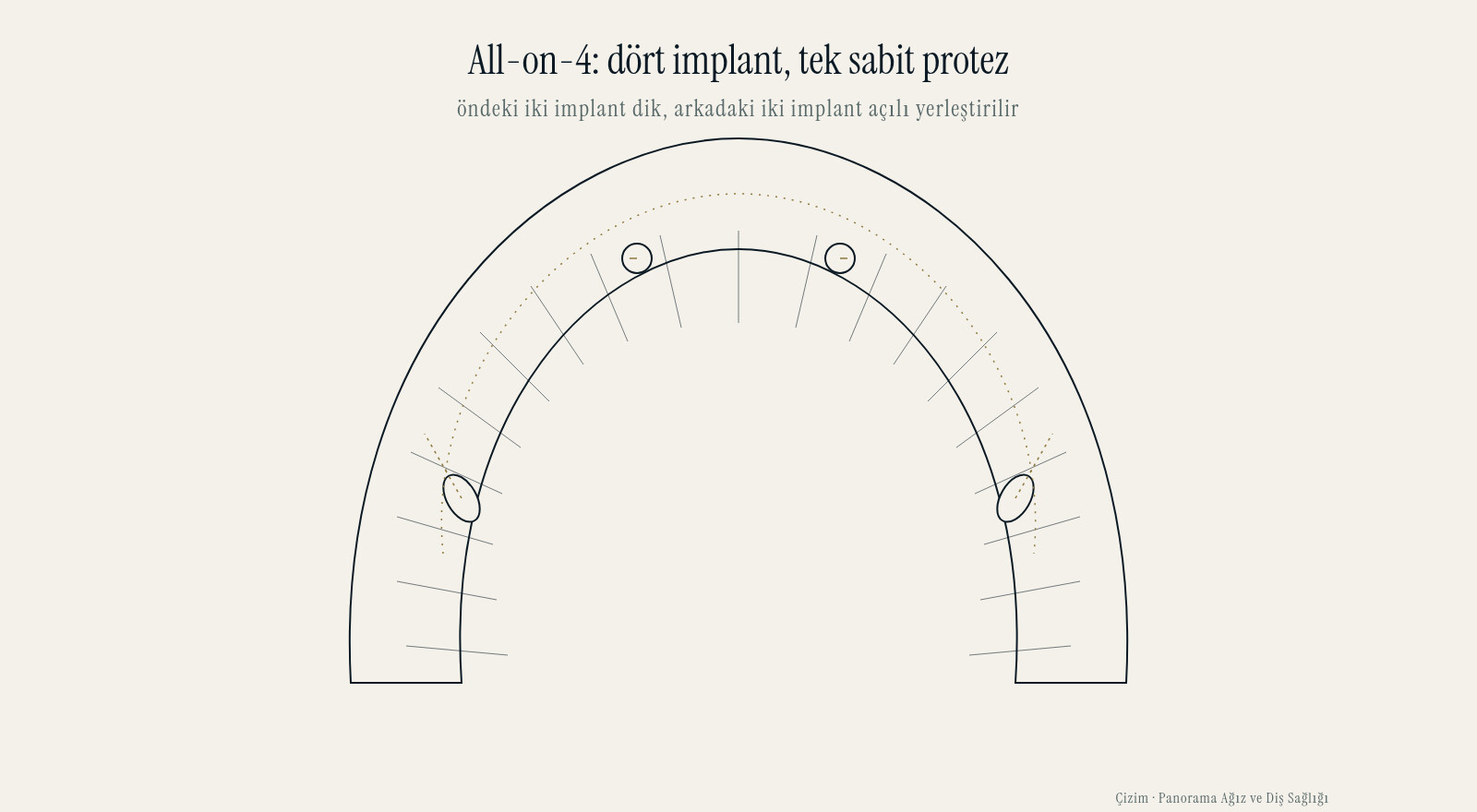
When no teeth remain in a jaw, there is no need to place a separate implant for every tooth. In the All-on-4 technique, four implants are placed at an angle to support a fixed prosthesis that carries the whole jaw; if bone volume allows, All-on-6 uses six implants. The greatest advantages of this approach are that in most cases you can leave the clinic with temporary fixed teeth the same day or within a few days, and that the need for bone grafting is reduced. Patients who move from a removable full denture to fixed teeth notice a marked change in chewing and speaking comfort. We explain who the method suits on our All-on-4 implant page.
How Long Do Implants Last? How Should You Care for Them?
A titanium screw cannot decay. With regular care and check-ups, implants can serve for many years; how long varies from person to person, with oral hygiene and general health. The crown on top, like a filling or a crown on a natural tooth, can wear and may need replacing over the years. The real threat to an implant is inflammation of the gum around it; this is called peri-implantitis, and just like gum disease, it starts with plaque build-up.
Implant care is really no different from caring for natural teeth: a soft brush twice a day, floss or an interdental brush every day, a check-up every six months and professional scaling. At the check-up your dentist measures the gum depth around the implant and, if needed, checks the bone level with an X-ray. Smoking is the biggest risk factor both during the integration period and afterwards; an implant is a good excuse to quit.
Risks of Implant Treatment and Possible Complications
As with any surgical procedure, results with implants vary from person to person and there are some risks; knowing them is part of making an informed decision about treatment. The most common problem is the implant failing to integrate with the bone: this is usually noticed in the first months, the implant is removed, and once the area has healed it can be attempted again. Proximity to the nerve canal in the lower jaw and to the sinus in the upper jaw are risks that can largely be avoided with proper CT planning. In the long term, peri-implantitis, inflammation of the gum and bone around the implant, is the most important threat, and it almost always stems from a lack of care or from smoking.
The good news: most of these risks can be managed with proper planning before surgery, following the post-operative instructions and keeping up with regular check-ups. Before starting treatment, do not hesitate to ask your dentist for the risks and alternatives specific to your situation in writing; the first sign of a good plan is that it can answer the question “why”.
Implant Treatment in Istanbul: Our Haliç and Pendik Clinics
At Panorama Oral & Dental Health, we provide implant treatment in Istanbul at our Haliç clinic on the European side and our Pendik clinic on the Asian side. Both clinics have CT scanning and digital planning facilities; planning, surgery and the prosthetic stages are all completed under one roof. You can meet our dentists on the Our Team page and book an examination through the contact page or by phone. For general information about treatment options and the process, our dental implant treatment page is also helpful.
Frequently Asked Questions About Dental Implants
How long does implant treatment take in total?
For a single implant, from examination to the permanent tooth takes 3-6 months on average. The surgical stage is a single session; most of the time is spent waiting for the implant to integrate with the bone. If a bone graft is needed, the timeline may be longer.
Does getting an implant hurt?
The procedure is performed under local anaesthesia and no pain is felt during it. Over the following 2-3 days there may be mild soreness and swelling, which is easily managed with the painkiller your dentist recommends and cold compresses.
Is there an age limit for implants?
The lower limit is the completion of jaw growth (usually around 18). There is no upper age limit; implants can also be placed in older patients whose general health and bone volume are suitable.
Can an implant be placed on the same day as the extraction?
If there is no active infection at the extraction site and the bone is sufficient, the implant can be placed in the same session as the extraction (immediate implant). Suitability is determined by CT scan and examination.
I was told I have too little bone. Does that rule out implants?
In most cases, no. The area can be built up with a bone graft or a sinus lift; in a fully toothless jaw, angled placement techniques such as All-on-4 can reduce the need for grafting. The options are planned after a CT scan.
Does an implant prevent me from having an MRI scan?
No. Titanium is not magnetic, so patients with implants can have MRI scans. Simply let the technician know that you have an implant before the scan.
When properly planned and regularly cared for, an implant is the closest thing to a natural replacement for a missing tooth; but every mouth is different. It is not possible to say which route is right for you without an examination and a CT scan. If something is on your mind, write to us or give us a call, and we will look at it together.